
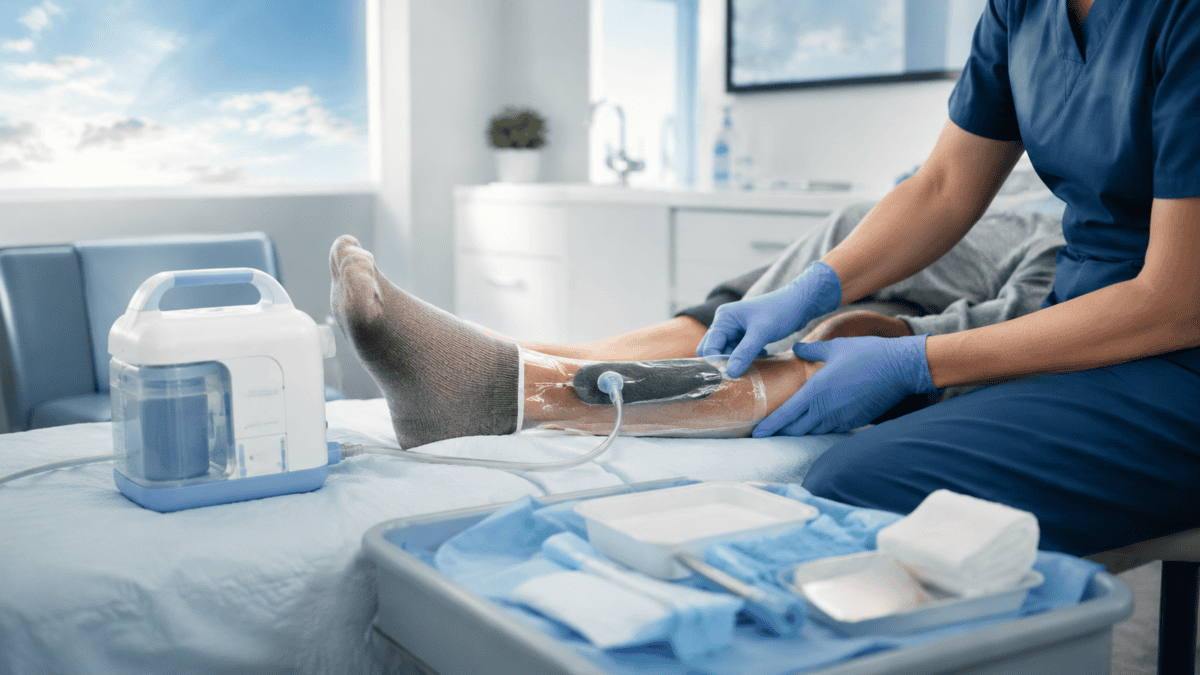
Negative pressure wound therapy (NPWT) can help selected wounds move toward a cleaner, shallower, better-controlled wound bed. This therapy removes exudate, reduces edema, and supports granulation tissue. For Medicare patients, coverage depends on wound type, prior standard care, monthly progress documentation, and stopping rules. Skin substitute planning should be reviewed separately once the wound bed is clinically ready.
Standard wound care protocols frequently fail when a wound enters a long, stubborn inflammatory phase. More than causing your Medicare patients pain, a stalled wound also drains your clinic's time and resources.
When this happens, you need therapies that push the tissue out of this stagnant state and into active growth. In selected cases, negative pressure wound therapy (NPWT) and advanced amniotic skin grafts may support different stages of wound care.
But managing the shift between these two treatments can create crushing paperwork headaches. For precisely this reason, we created our White Glove Service: To take that weight off your shoulders. From managing shipping logistics to helping prevent billing rejections, we’re here for you.
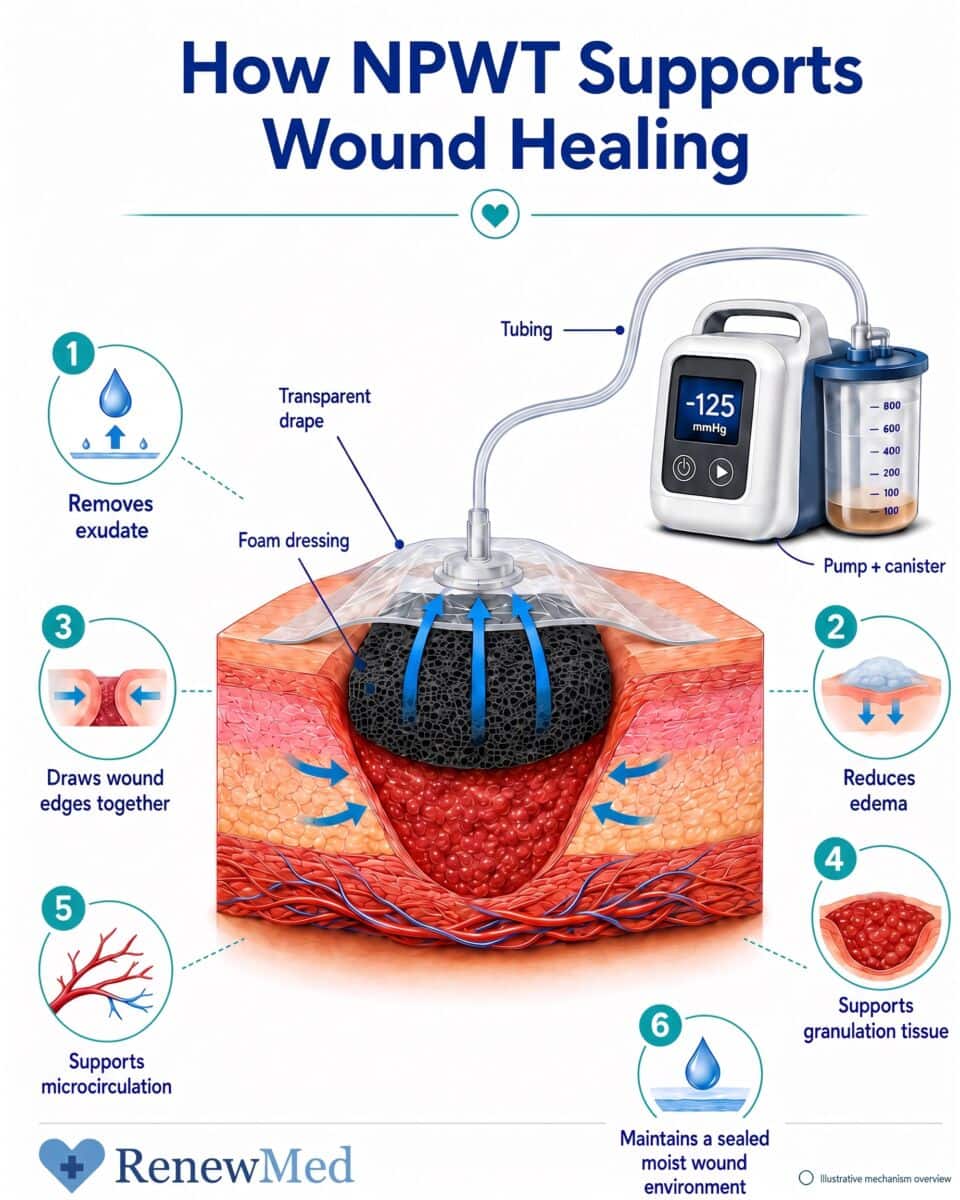
You know how to apply a foam dressing and turn on a pump. But for a smooth transition, you need to look at how this mechanical force changes the wound bed. A vacuum pump can help create a cleaner, better-controlled wound bed before the next treatment decision.
Vacuum-assisted closure does a few vital things at once.
The combination of fluid clearance and cellular tension creates the perfect home for bright, healthy granulation tissue. It turns a stalled wound into an active healing zone.
NPWT is an excellent solution for deep cavities, Stage 3 or 4 pressure injuries, and neuropathic, venous, or arterial insufficiency ulcers that lack healthy tissue.
It manages the fluid influx that would normally soak right through standard dressings.
However, many clinics struggle during the initial setup phase, facing billing rejections.
According to official Medicare coverage definitions, you must show that standard wound care failed first when treating chronic wounds. For home-setting chronic ulcers, Medicare requires a qualifying wound type and evidence that a full wound therapy program was either tried or considered and ruled out before NPWT.
We regularly see clinics face initial claim denials because they don't document the precise conservative treatments they tried before ordering pump supplies, or they misunderstand the timeline rules.
Medicare requires a qualifying wound type and proof that a complete wound therapy program was either tried or considered and ruled out prior to NPWT for home-setting chronic ulcers.
Before NPWT can start, you must clearly document the
Traumatic wounds, surgically created wounds, and dehisced incisions do not require a 30-day conservative care period.
You can initiate a vacuum pump immediately if it meets medical necessity, but your initial chart notes must explicitly state the wound type to avoid automated claim rejections.
RenewMed Tip: To safeguard your revenue from post-payment audits, your clinical charts must show steady progress. Always measure the length, width, and depth. This objective tracking satisfies strict reviewer guidelines.
While this mechanical system is useful, it’s not for every wound. Applying suction to the wrong environment can cause serious harm or severe bleeding. And remember to make sure that the wound bed is clean before you turn on the pump.
Never apply the vacuum system if you notice any of these issues.
RenewMed Tip: If you're treating a Medicare patient, you also need to look closely at your monthly progress notes. In order to keep the coverage, the wound must be checked regularly, and its size and shape must be recorded at least once a month. Insurers expect to see steady, measurable shrinkage in the wound's size.
NPWT can help prepare selected wounds for the next treatment decision, but it’s not an automatic bridge to an amniotic graft.
Before using a skin substitute, reassess the
If you leave a patient on a vacuum system for too long, you risk causing hypergranulation. This creates a bumpy, uneven surface that'll reject new tissue. If you apply a biologic to a deep, fluid-heavy wound, the risk that the treatment will fail becomes much bigger. In these cases, you also run a risk of being audited and your claim being rejected.
You need hard data to guide your transition from the pump to biological skin grafts. Never rely on guesswork or estimations.
You can transition your patient to a dermal substitute when you hit these targets.
Although Medicare coverage has a 4-month limit, the timing for reassessment varies by wound depth, drainage, tissue quality, patient factors, and payer criteria.
RenewMed Tip: Don't wait until the wound stalls on the pump to order your biologic. Once you notice the wound bed has reached about 80% granulation, that's your cue. Contact your dedicated consultant. We’ll help verify coverage, documentation needs, payer requirements, and product logistics early.
Managing complex wounds requires the right tool at the right moment. Yet, building a smooth protocol that pairs mechanical systems with advanced biological grafts takes time and meticulous planning.
You shouldn't have to spend your days fighting through mountains of insurance paperwork just to give your patients the care they deserve.
We built our national service integrator model to step in as an extension of your practice. Our team helps you streamline this process from start to finish. We assist with the administrative details so you can focus on your clinical care.
Let us help you streamline your clinical protocols.
Connect With a RenewMed Consultant Today
Our team will handle the Medicare authorization hurdles so you can stay focused on healing.
For home-setting chronic ulcers, Medicare looks for a qualifying wound type and a complete wound therapy program before NPWT.
Your notes should include:
Skin substitutes tend to perform poorly if the wound bed is still too wet, infected, necrotic, poorly perfused, or exposed to shear. Timing matters, but it is only one factor. Reassess the full wound environment before applying the graft.
Monitor tissue level at each dressing change. If granulation rises above the wound edges, reassess pressure settings, dressing type, wear time, and the broader care plan.
Yes. Medicare coverage may end earlier than four months if the wound has healed enough to stop NPWT, if no measurable healing occurs over the prior month, or if the pump and supplies are no longer being used. Four months is a limit, not a treatment goal.
A common starting point is -125 mmHg. Yet, always follow the prescriber’s order, device guidance, dressing type, wound features, and patient tolerance. Avoid treating -150 mmHg as the default next step for heavy drainage.
Contact RenewMed Today to Provide Optimal Wound Care
Sources used:
Disclaimer: This content is created for licensed healthcare professionals, offering educational insights into wound care. It is not intended as medical advice or to replace your own clinical judgment when treating patients. We're here to support you, but the final treatment decisions should always be based on your professional evaluation of each unique patient's needs.
