
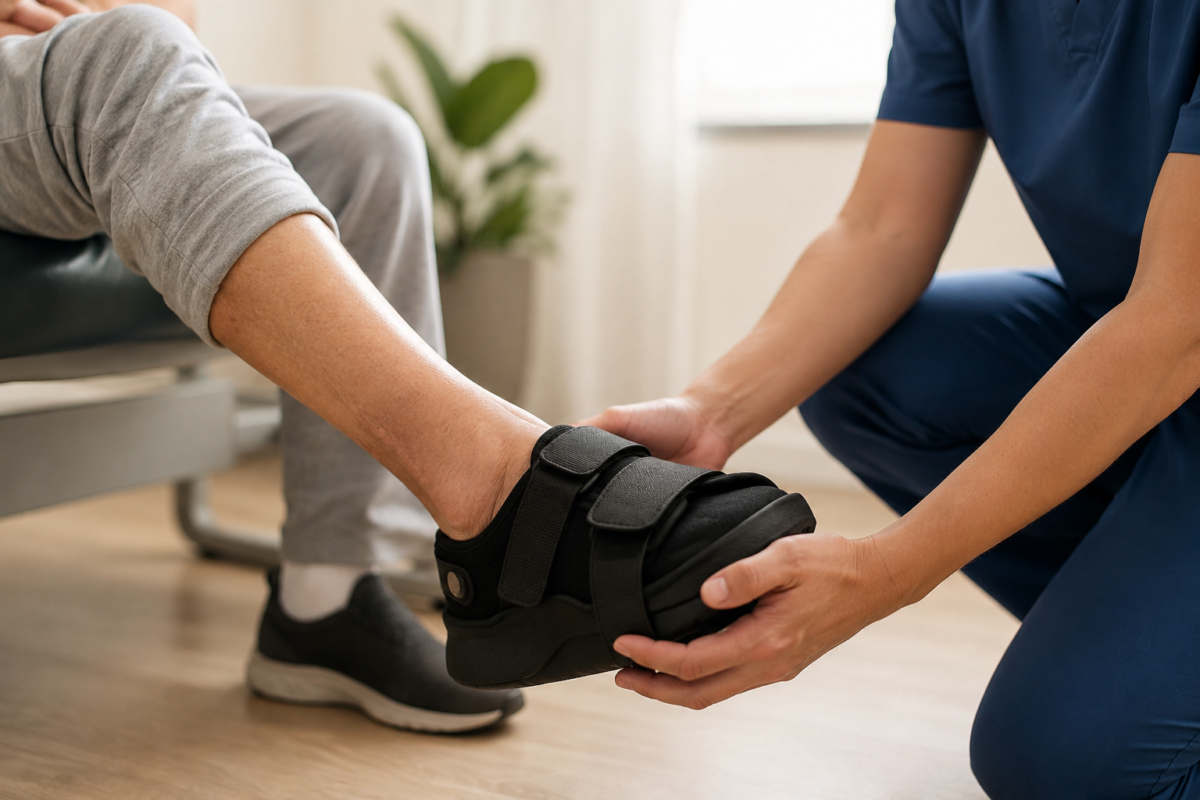
It’s beyond frustrating. Your best clinical DFC work can be undone by a single walk to the bathroom.
Offloading techniques for diabetic foot ulcers are the physical shield that makes healing possible. If you don't remove the repetitive trauma of every steps, a DFU will stay stuck in a chronic inflammatory loop forever.
It’s like trying to grow grass on a busy footpath. It doesn't matter how much water and fertilizer (or biologics) you add if people keep walking there.
Using advanced offloading and grafts together creates a protected environment where healing can finally take root. At RenewMed, we see offloading is the foundation. Beyond just "supportive care," it’s a first-line intervention.
You can apply the most advanced biologic in the world, but if the patient is still walking on the wound, it won't heal. This guide explores the "compliance gap" in offloading techniques for DFU and provides a hierarchy of pressure-reduction methods designed to protect both the wound bed and your clinical outcomes.
Use this decision framework to select the right modality for your DFU patient.
When it comes to offloading techniques for diabetic foot ulcers, the Total Contact Cast is the undisputed heavyweight champion. In fact, healing rates for neuropathic plantar ulcers in a TCC range from 73% to 100%.
It works by distributing the patient’s weight over the entire surface of the lower leg and foot, rather than concentrating it all on the ulcer.
The superiority of TCC is forced compliance.
However, TCC isn't for everyone. You shouldn't use it on:
TCC isn't always easy to implement. It requires a specific skill set, weekly cast changes, and patient buy-in.
Removable Cast Walkers (RCWs) are the most common offloading techniques for diabetic foot ulcers because they're easier for clinicians to apply and allow for daily wound checks.
But they come with a "compliance gap." When a patient can take the boot off, they will.
Research using hidden activity trackers has shown that patients only wear their removable offloading devices about 28% of the time they're actually on their feet. Because neuropathy removes the pain, the patient doesn't feel the damage they're doing with every "unprotected" step around the house.
Common Offloading Modalities at a Glance
|
Modality |
Description |
Healing Rate (12 wks) |
Best For |
Pros |
Cons |
|
Total Contact Cast (TCC) |
Custom-molded fiberglass or plaster cast that encompasses the leg and foot. |
~89% - 90% |
Non-infected, non-ischemic plantar DFUs. |
The "Gold Standard"; eliminates patient non-compliance; maximum pressure reduction. |
Requires specialized training to apply; time-consuming; cannot inspect wound daily. |
|
iTCC (Instant Total Contact Cast) |
A standard CAM walker boot "locked" with cohesive wrap or zip-ties to prevent removal. |
~70% - 82% |
Busy clinics needing high efficacy without the time of a full cast. |
Faster application than TCC; much higher healing rates than removable boots. |
Still bulky; requires the clinician to "unlock" the device for wound checks. |
|
Non-Removable Boot |
Any knee-high walking brace that has been modified to be non-removable by the patient. |
~65% - 75% |
Patients who need the stability of a boot but lack the compliance to keep it on. |
High efficacy; easier to implement in a primary care or small clinic setting. |
Heavy; can cause "hip-hike" or gait issues if not balanced with a lift on the other shoe. |
|
Removable Walker |
A standard, removable CAM walker/boot. |
~50% |
Low-risk ulcers in highly compliant, reliable patients. |
Easy wound access; allows for daily hygiene and dressing changes. |
Poor compliance; patients often remove it for "just a few steps" at home. |
|
Post-Op Shoe |
Flat-soled, stiff-bottomed shoe with Velcro straps. |
~25% - 30% |
Small, non-plantar wounds or very low-risk digits. |
Inexpensive; lightweight; easily fits into the patient's wardrobe. |
Minimal pressure reduction; high risk of "rocking" motion that shears the wound. |
|
Felt/Foam Padding |
Layers of felt or foam applied directly to the skin or as an insert. |
Variable (<30%) |
Digital (toe) ulcers or as a temporary bridge to a better device. |
Very low cost; can be customized to "donut" a specific area. |
Flattens quickly; moves with the skin rather than redistributing weight away from it. |
H2: Combining Offloading with Advanced Wound Therapies
This is where the real results happen. By using offloading techniques for diabetic foot ulcers to stabilize the mechanical environment, you create a "safe zone."
In this zone, an amniotic membrane graft can do its best work. Without the constant shearing and crushing forces of walking, the growth factors in the graft can stay in place and build the new tissue scaffold.
To secure reimbursement for amniotic grafts, Medicare requires 30 days of detailed, documented standard care. This must include:
Offloading is a difficult multi-month commitment. It’s hard for the clinician to apply and hard for the patient to live with. But it’s the only way to save a foot.
To help ease this burden, the RenewMed White Glove Service steps in as an extension of your clinic to manage the admin.
We:
In short, we’re here to help you manage the logistics and protect your revenue so you can focus on the technical art of keeping your patients mobile.
Reach out to our consultants today to start streamlining your advanced wound care.
What is the gold standard for offloading a DFU?
The non-removable Total Contact Cast (TCC) is considered the gold standard. It provides the most consistent pressure reduction and eliminates the risk of patient non-compliance, which is the leading cause of stalled DFU healing.
How long should offloading continue after healing?
New skin is fragile. We recommend continued offloading or therapeutic footwear for at least 2 to 4 weeks after complete closure to prevent immediate recurrence.
Can I use a regular surgical shoe to offload a plantar ulcer?
Generally, no. A surgical shoe or "wedge" shoe provides significantly less pressure reduction than a knee-high boot or TCC. They should only be used as a last resort or for wounds on the tips of the toes.
Can I use felt padding instead of a boot?
Felt-and-foam can be used for small, non-plantar wounds or as an adjunct but are considered sub-optimal for primary plantar ulcers compared to cast-level devices.
What if the patient refuses a non-removable device?
Document the education provided and the patient's refusal. In these cases, move to a removable walker, but warn the patient that the healing time will likely double, and insurance may not approve advanced grafts if standard care isn't fully optimized.
How often should a TCC be changed?
Typically every 7 days. This allows for wound assessment, debridement, and re-application of any advanced biologics.
Can I use TCC if the patient has PAD?
Severe PAD (ABI <0.5) is a contraindication. For moderate disease, you can use offloading but must monitor the patient’s digits for signs of ischemia very closely.
How do you know if offloading is working?
The most immediate sign is a change in the wound edge. If the callus around the wound begins to soften or thin, and you see new "silver" skin migrating from the edges, your offloading is successfully reducing the mechanical stress.
What is "Instant" Total Contact Casting (iTCC)?
This involves taking a standard removable cast walker and using a cohesive bandage or security seal to make it non-removable. It provides the clinical benefits of TCC with the ease of a pre-made boot.
How do I document offloading for a patient who is wheelchair-bound?
Offloading is still required! Even if they aren't walking, they may be "heel-propping" or resting the foot on a hard surface. Document the use of specialized cushions or "offloading boots" designed for non-ambulatory patients.
Does RenewMed provide the offloading boots?
While we specialize in advanced grafts, we function as a service integrator. We can help you navigate the DME requirements and documentation needed to ensure your patient has the foundation required for grafts to work.
Does Medicare pay for offloading for DFUs?
Yes, Medicare does cover offloading therapies under a few different categories depending on what you prescribe. It’s considered a medically necessary standard of care for wound healing.
However, proper documentation of the ulcer and risk factors is a must.
Stop letting mechanical pressure undo your clinical hard work. Join us in making a difference for your patients by protecting every step toward closure.
You handle the healing; we’ll handle the hurdles.
Together, let’s restore hope, one patient at a time.
Sources used:
Disclaimer: This content is created for licensed healthcare professionals, offering educational insights into wound care. It is not intended as medical advice or to replace your own clinical judgment when treating patients. We're here to support you, but the final treatment decisions should always be based on your professional evaluation of each unique patient's needs.
