
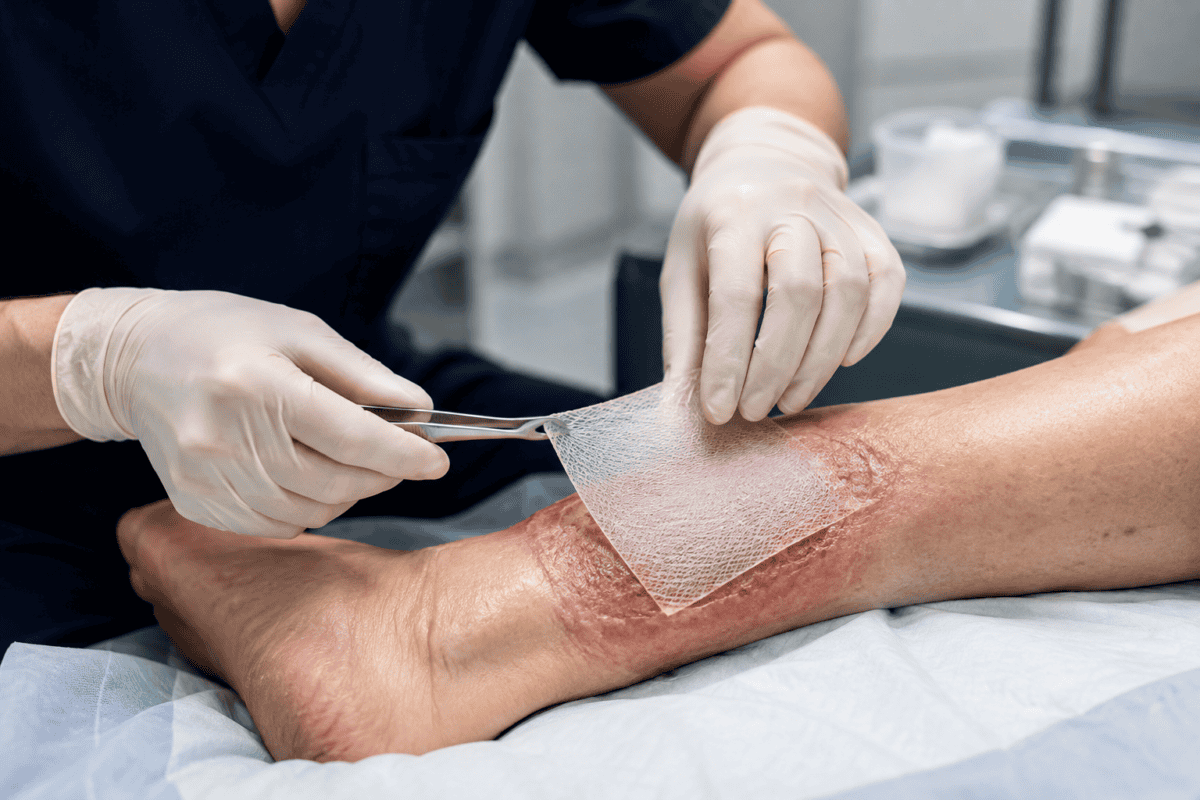
A safe skin substitute application technique starts before you open the product. For Medicare patients, providers must confirm wound eligibility and document failed standard care first. Then, prepare a clean wound bed, follow the product's exact IFU, and secure full wound-bed contact. Finally, record product details, wastage, measurements, and clinical responses to support medical necessity.
For Medicare patients, your skin substitute application technique and charting are inseparable.
A clean wound bed, correct product handling, and secure fixation help the patient heal. But your claim still depends on proving medical necessity, following MAC rules, and keeping comprehensive notes.
At RenewMed, we know your clinical skills are your greatest asset. Partnering with our team gives you access to advanced cellular and tissue-based products (CTPs). We also give you the operational guidance to apply them confidently. We handle the admin so you can focus on the patient’s treatment.
Let's break down the step-by-step protocol to support consistent application and cleaner documentation.
You need to start strong. If the wound bed isn't ready, the biologic might not maintain contact or perform as intended.
Before you prep the patient, review their chart. You've got to confirm the wound meets your specific Medicare Administrative Contractor (MAC) guidelines. Make sure that your notes reflect the failed standard care trial and that you’ve treated or controlled any active infection or underlying barrier to healing.
You must remove all dead tissue as clinically needed. You can use a sharp debridement to clear away slough, eschar, and biofilm. However, the debridement method must match the patient, wound, and provider scope. The goal is a clean, viable wound bed suitable for the selected product.
You want a vascular bed, but you can't place a graft into active bleeding. Stop the bleeding using gentle pressure. Once it stops, take precise measurements of the final wound.
RenewMed Tip: Skin substitutes are covered being used as a wound covering and scaffolding for cell growth.
Treat the CTP carefully to protect its delicate structure. Open the sterile packaging and follow the Instructions for Use (IFU) exactly. If the product needs hydration, soak it in sterile saline for the specified time.
Don't guess; always follow the manufacturer's guidelines.
RenewMed Tip: Record the product name and HCPCS code, where relevant, in your application note. You must also include the package size, expiration date, and the specific manufacturer lot, serial, batch, or other unit identification number.
For non-BLA skin substitutes treated as incident-to supplies from January 1, 2026, CMS says JW and JZ modifiers are not appropriate. Discarded units are not payable.
You should only bill for the portion you apply and document any waste clearly. Always check your current MAC rules before you bill.
To maintain consistency and compliance, use this procedural checklist for every application.
You must anchor the graft so it doesn't move. Depending on the wound and the IFU, you might use steri-strips, tissue adhesive, sutures, bolsters, or non-adherent dressings.
The goal is to prevent the graft from making any micro-movements and keep it in direct contact with the wound bed.
The right dressing protects your work.
If it isn't documented, Medicare assumes it didn't happen. Your procedural notes must match your clinical actions.
Record exactly how you prepped the wound, the product you used, and how you secured it.
This detailed charting helps support your claim under the 2026 payment rules. These rules reimburse many non-BLA incident-to supplies at a flat rate of about $127.14/cm² when used as part of a covered application procedure.
Schedule follow-up visits after the skin substitute application to check the wound. You must monitor how well the graft sticks and track the healing progress.
RenewMed Tip: Many Medicare policies limit skin substitute use during a single episode. For example, some allow up to 10 applications in 12 weeks. Every repeat application needs new wound measurements, a documented response, and a clear reason to keep going.
Managing application technique, product logistics, and Medicare documentation can add pressure to an already busy wound care workflow. But there is a better way.
Our White Glove Service is designed to handle the logistical hurdles for you. We track your authorizations and make sure your preferred advanced wound care biologics arrive exactly when you need them.
Contact a RenewMed consultant today for the operational support your clinic deserves.
Your clinical expertise; our operational backing. Together, we can safeguard your practice and patient care.
Under the finalized 2026 Medicare rules, most non-BLA skin substitutes are classified as incident-to supplies. The group pays a national flat rate of about $127.14/cm² that you apply.
For non-BLA incident-to supplies, CMS says JW and JZ modifiers are no longer needed. Discarded units don't get paid.
Only bill for the exact amount you apply, but still note the waste in your chart.
Yes, if they fit the product's IFU and are needed for mobile areas. But for flat, shallow wounds, steri-strips or a non-adherent dressing are often enough to secure the matrix.
If you apply the graft while the wound is bleeding, a hematoma can form underneath it. This blood pool lifts the skin substitute away from the tissue, preventing the necessary cellular contact and causing the application to fail.
This depends on your local MAC rules. Generally, it means the wound hasn't shown any measurable signs of healing after a documented period of standard care, often at least 4 weeks or 30 days.
Standard care may include debridement, infection control, moisture/exudate management, vascular assessment, DFU offloading, VLU compression, and management of contributing conditions.
Sources used:
Disclaimer: This content is created for licensed healthcare professionals, offering educational insights into wound care. It is not intended as medical advice or to replace your own clinical judgment when treating patients. We're here to support you, but the final treatment decisions should always be based on your professional evaluation of each unique patient's needs.
