
For a patient with a VLU, every step feels like walking through deep water. The wound isn’t the main problem; it’s the gravity-driven pooling of blood that turns a simple scratch into a chronic hole.
Compression therapy for venous leg ulcers (VLU) is the engine of healing these wounds.
Without external pressure to assist the calf muscle pump, the wound bed remains "drowned" in inflammatory fluid. By using modern compression systems and advanced biologics, you can effectively push the fluid out and let the healing begin.
Compression therapy is the foundation of healing a VLU, but when the foundation alone isn't enough, RenewMed provides the "building blocks" (the grafts) that finish the job.
Venous insufficiency is a mechanical failure that requires a mechanical solution. This guide on compression therapy for venous leg ulcers outlines the protocols for applying compression safely and identifying the exact moment to add advanced biologics to the mix.
Venous leg ulcers happen because of a plumbing failure. When the valves in the leg veins stop working, blood pools, pressure rises, and the tissue eventually breaks down.
Compression therapy directly fights this failure. By applying external pressure, you're physically shrinking the diameter of the veins, forcing the valves to close better, and pushing fluid back into circulation.
It’s a mechanical solution to a mechanical problem.
This external pressure does three vital things.
Effective compression isn't just a tight wrap. It must be graduated—highest at the ankle (typically 40 mmHg) and decreasing as it moves toward the knee.
Without this gradient, you risk creating a "tourniquet effect" that actually traps blood in the lower leg. Technique matters just as much as the bandage you choose.
Compression is powerful, but in the wrong hands, it’s dangerous. The biggest risk in VLU management is applying high-level compression to a patient with undiagnosed Peripheral Artery Disease (PAD).
If the arterial inflow is already restricted, adding external pressure can cause localized ischemia or even necrosis.
RenewMed Tip: Before you apply that first layer, ensure your documentation reflects a clear "vascular clearance."
If you’re ever unsure about a patient's arterial status, your RenewMed consultant can help you through the diagnostic steps needed before you move forward with a treatment plan.
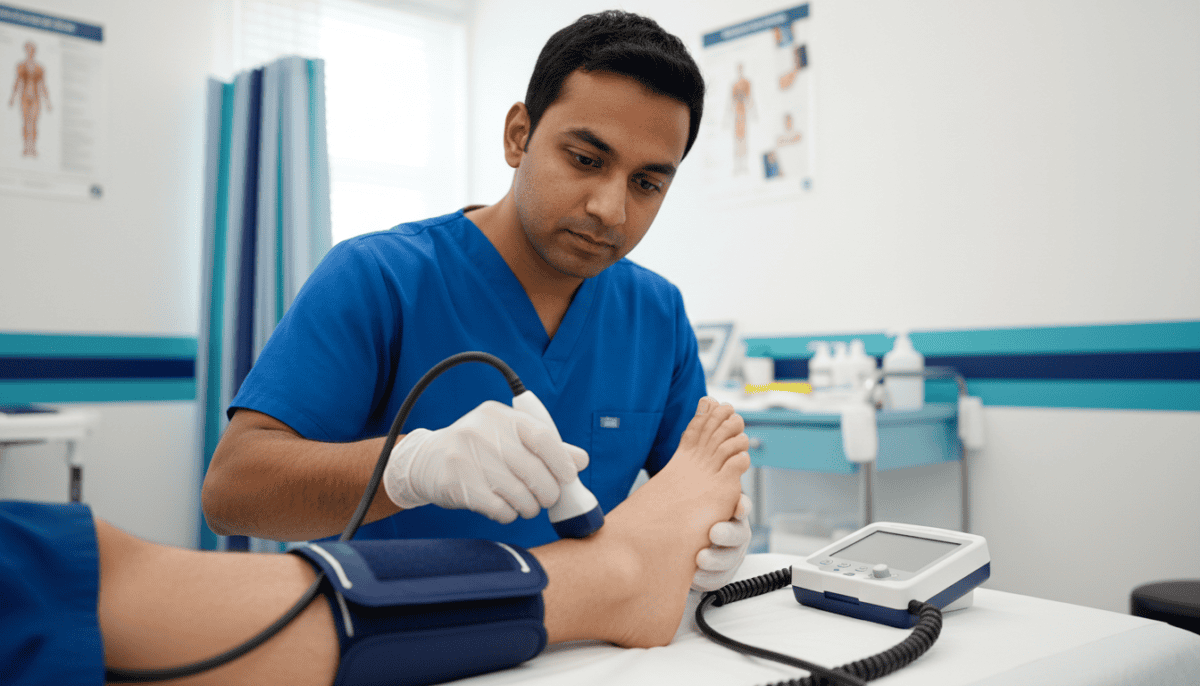
Before starting compression therapy for venous leg ulcers, you must perform an Ankle-Brachial Index (ABI).
RenewMed Tip: Measure the patient’s ABI readings at every visit and document it clearly.
There is no one-size-fits-all system. Your choice depends on the patient's ABI, their level of mobility and lifestyle, the wound’s exudate levels, and your clinical goals.
Use this comparison table to start your selection process.
|
System Type |
Compression Level |
Primary Indication |
Best For |
Provider Consideration |
Pros |
Cons |
|
4-Layer Wrap |
High (35–40 mmHg) |
Large, highly exudative active VLUs. |
Non-mobile patients or those with irregular limb shapes. |
Requires high clinical skill to apply; expensive per-application. |
Consistent, sustained pressure for up to 7 days. |
Bulky; difficult to wear standard shoes; high nursing time. |
|
2-Layer Cohesive |
High (35–40 mmHg) |
Active VLUs with moderate drainage. |
Mobile patients who want a lower profile. |
Faster to apply than 4-layer; less risk of slippage. |
Comfortable; low profile; reduces application time by 50%. |
Less absorbent than 4-layer systems. |
|
Short-Stretch |
High working / Low resting |
Lymphedema or mixed-etiology ulcers. |
Active patients with a functional calf-muscle pump. |
Safe for patients with lower ABIs (0.5–0.8). |
High working pressure during walking; easy to reuse. |
Loses pressure quickly; requires frequent re-wrapping. |
|
Zinc Paste (Unna Boot) |
Static / Inelastic |
Small ulcers or pediatric / elderly patients. |
Fragile skin or patients sensitive to adhesives. |
Messy to apply; does not accommodate volume changes. |
Soothes skin; protects from trauma; cost-effective. |
No compression when the patient is at rest; high risk of odor. |
|
Velcro Wraps |
Custom (20–50+ mmHg) |
Chronic edema or long-standing VLUs. |
Patients who want to self-manage or shower daily. |
Enables supported self-care; saves clinic resources. |
Highly adjustable; durable / reusable; improves compliance. |
High upfront cost; requires patient dexterity. |
|
Class 3 Hosiery |
Strong (34–46 mmHg) |
Severe CVI or prevention of VLU recurrence. |
Healed patients or very low-exudate ulcers. |
Difficult for elderly or arthritic patients to apply. |
Proven to reduce recurrence by 70%; discrete. |
High physical effort required to don/doff. |
Unfortunately, even with perfect compression, some venous ulcers won't heal. If you don't see a 50% reduction in area by week 4, you've reached a decision point.
Continuing the same wrap for another 6 months isn't a working strategy. Chronic venous ulcers often suffer from "biological fatigue," where the local growth factors are simply exhausted.
This is where advanced biologics, like amniotic membrane grafts, become vital. They don't replace the wrap; they work alongside it.
By placing the graft directly onto the cleaned wound bed before reapplying the compression wrap, you're giving the body the biological signals it needs to bridge the gap. The wrap handles the macro-circulation (the pressure), while the graft handles the micro-circulation (the tissue repair).
Managing VLUs is a long-term commitment. You need a partner who understands the nuances of vascular health and the administrative hurdles of high-end biologics.
Our White Glove Service is designed to support your practice by absorbing your administrative wound care pressure.
We provide:
Now, you can turn all your focus on the pressure of treating chronic wounds.
Reach out to RenewMed today to boost your venous ulcer outcomes.
What is a 4-layer compression dressing for venous ulcers?
A 4-layer system consists of a padding layer, a light crepe bandage, a compression bandage, and a final cohesive bandage. This system is designed to provide sustained, graduated pressure while managing the high levels of drainage often seen in venous wounds.
What if the patient finds 4-layer wraps too bulky?
Consider a 2-layer cohesive system. These provide similar graduated pressure but have a lower profile, making it easier for the patient to wear their own shoes.
Why does the leg need to be "offloaded" before wrapping?
It’s best to apply compression while the leg is elevated or before the patient gets out of bed. This ensures you are "holding" the leg in a reduced state of edema rather than trying to compress a leg that is already swollen.
How do you manage venous leg ulcers using compression therapy and dressings?
The process involves three steps:
What happens if I don't use compression on a venous ulcer?
Without compression, the underlying venous hypertension remains. This means the wound will likely stay stuck in a chronic inflammatory state, and even if it does heal, the risk of the ulcer returning is extremely high.
Can compression socks heal a venous ulcer?
Standard compression socks (Class 1 or 2) are usually meant for prevention. For active ulcer healing, you typically need the higher therapeutic pressure (30–40 mmHg) provided by multi-layer bandages or Class 3 hosiery.
Can I wear compression socks at night?
Generally, no. Compression socks are designed to fight gravity while you are upright. When you lie flat, your heart doesn't have to work as hard to return blood from the legs, so the high pressure of the socks is usually unnecessary and can be uncomfortable.
Can I use compression if the wound is infected?
Moderate compression can sometimes be used with an infection to help move inflammatory fluid away, but the infection must be treated primarily with antibiotics and debridement. High-level compression may be paused if the pain is too severe during the acute infection phase.
How do I know if the compression is too tight?
If your patient experiences numbness, tingling, or their toes turn blue or dusky, the compression is too tight or there is an underlying arterial issue.
Remove the bandages immediately and re-evaluate their vascular status.
What if the patient has "mixed" disease?
If a patient has both venous and arterial issues (ABPI 0.5-0.8), you must use "reduced" compression. Applying full pressure can cut off the already limited arterial flow.
H3: Restoring Flow, Renewing Life
Stop struggling with wounds that refuse to move. Join us in making a difference for your patients by turning "stalled" into "closed."
Every healed wound represents a life improved. Let's get there together.
Sources used:
Disclaimer: This content is created for licensed healthcare professionals, offering educational insights into wound care. It is not intended as medical advice or to replace your own clinical judgment when treating patients. We're here to support you, but the final treatment decisions should always be based on your professional evaluation of each unique patient's needs.
