
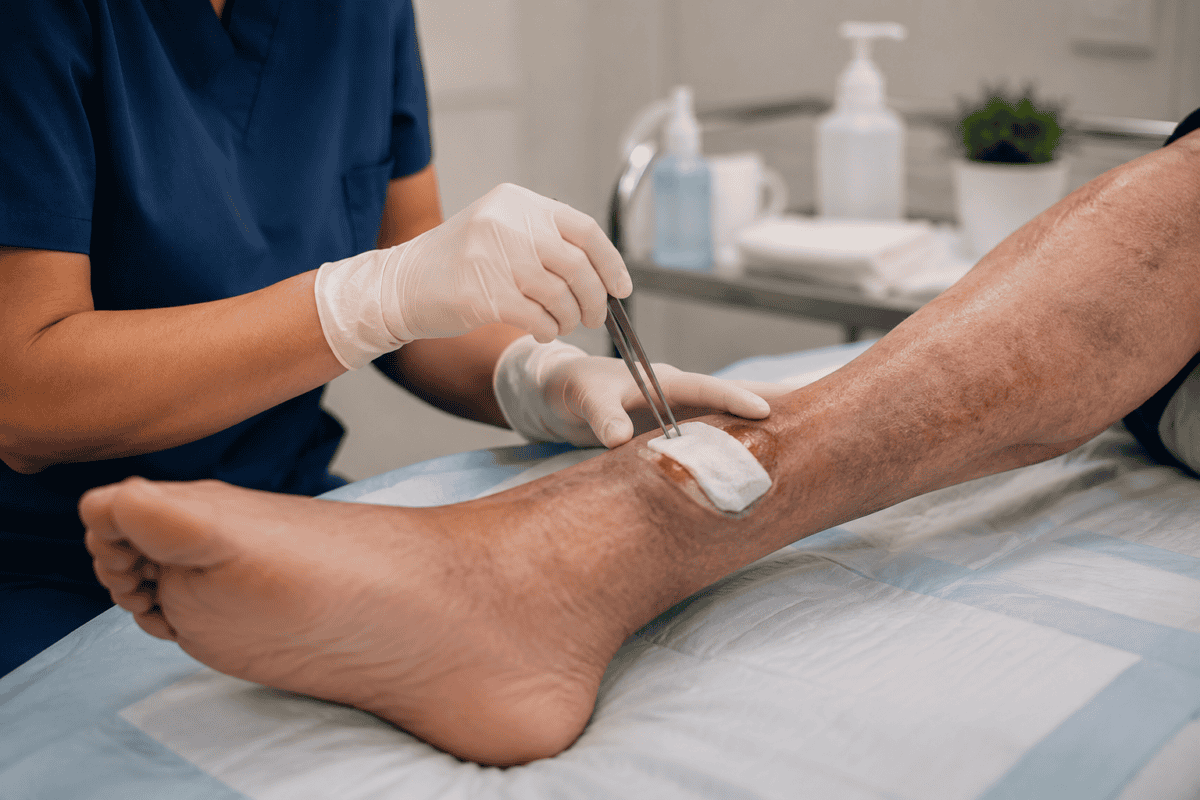
You wouldn't paint a house while the wood is rotting. Just so, you shouldn't apply an advanced therapy to a wound bed that isn't ready.
Wound bed preparation principles are about one thing: Removing the barriers that keep a wound from healing itself.
By following a systematic approach, you can make sure that every advanced wound care product you use has the best possible chance of "taking."
The principles of wound bed preparation build a systematic process to remove the healing barrier keeping ulcers from closing. We explore the "TIME" framework to help you create an optimal biological foundation and identify when a wound is ready to receive the advanced therapies.
The global standard for preparing a chronic wound bed is the TIME framework. It’s a simple, four-part mnemonic that helps you address the most common reasons wounds stall.
If you can't check off all four of these boxes, the wound isn't ready for an advanced graft.
However, TIME is not a one-and-done checklist. It’s an iterative tool. You might achieve a clean bed on Monday, only to have biofilm re-established by Thursday.
TIME works best when you use it at every visit to gauge healing potential.
While frameworks evolve, the 4 core principles you’ll apply daily are:
The "T" in TIME is your starting point. Necrotic tissue, slough, and eschar act as a physical wall that blocks growth factors and new cells. Dead tissue is also a breeding ground for bacteria.
You cannot build healthy tissue on a foundation of decay. Debridement is the most critical of the wound bed preparation principles because it resets the wound’s biological clock.
RenewMed Tip: When prepping for a biologic, aim for a "clean and granular" bed. If you see yellow slough or gray, non-viable tissue, the graft will not have the necessary contact with the capillary bed to succeed.
Nearly 90% of chronic wounds harbor biofilm, so you must assume it’s there even if you can't see it.
Biofilm also begins rebuilding its structured microbial community within 24 hours of disruption and can fully mature in 72 hours. This is why "maintenance debridement" is critical.
If you only debride when you see obvious slough, you're giving the biofilm a chance to fortify. Weekly sharp debridement keeps the window of vulnerability open so your treatments can actually reach the bacteria.
A wound "stuck" in the inflammatory phase is a wound that isn't healing. When wound bed preparation principles are applied correctly, you’re looking for the "5 P's of wound care" (Pain, Pallor, Pulselessness, Paresthesia, Paralysis) to rule out deep vascular issues, but your daily fight is against local bioburden.
If you see increased redness, heat, or a sudden spike in exudate, the "I" in TIME needs your attention.
Infection and inflammation are two sides of the same coin.
If you suspect critical colonization, topical antimicrobials are your first line. Reserve systemic antibiotics for wounds with clear systemic involvement (fever and cellulitis).
Use antimicrobial washes or dressings to lower the bacterial count before you consider a biological graft. An amniotic membrane applied to an infected bed will simply be "eaten" by the bacteria.
Moisture is a double-edged sword. A dry wound bed prevents cell migration, but an overly wet wound bed contains "toxic" fluid full of inflammatory markers that break down healthy skin.
The ideal bed for an amniotic graft is "glistening" but not "weeping." If your dressing is saturated within 24 hours, you need to address the underlying cause, usually venous insufficiency or high bioburden, before applying an expensive biologic.
The "E" in the TIME framework represents the Edge of the wound, and it’s your definitive clinical barometer. While the wound bed (Tissue, Infection, Moisture) tells you about the current environment, the edge tells you if your treatment plan is actually winning.
In a healthy wound, the edges (the epithelium) should be thin, silver-pink, and actively migrating toward the center to close the gap.
If the epidermal margin isn't closing, the wound remains "stalled," regardless of how clean the bed appears.
You are looking for a "shelving" effect where the skin gradually slopes into the wound. Conversely, a problematic edge presents in two primary ways.
When you identify epibole or stalled margins, your wound bed preparation principles must shift toward mechanical stimulation.
RenewMed Tip: Documentation of "stalled edges" or "epibole" is high-value data for reimbursement. It provides the clinical justification that standard moist wound healing (MWH) has failed, even if the wound bed is otherwise clean, making the case for advanced biologics clear to the payer.
One of the most common "administrative pains" we help providers manage is the 2026 Medicare "30-day rule." To be eligible for reimbursement, you must document that you have applied these wound bed preparation principles for at least 30 days without sufficient progress.
When is the bed officially ready?
This is the "Golden Window." The bed is clean (Tissue), the infection is controlled (Infection), the moisture is balanced (Moisture), but the body's own cells don't have the energy to finish the job.
This is where an amniotic membrane graft acts as the ultimate catalyst.
If you've plateaued with standard care, don't wait forever; contact your RenewMed consultant to get the claim started.
A stalled, clean wound is screaming for the growth factors and scaffolding that an amniotic graft provides.
How often should I reassess an ulcer using TIME?
At every visit. Chronic wounds are dynamic. A bed that was "ready" last week will have a new biofilm barrier this week.
What is the "Rule of 50" in wound prep?
If a wound hasn't reduced in size by 50% after four weeks of following these principles, it’s a clear signal to escalate to advanced therapies like amniotic grafts.
How do I know if a wound is too wet or too dry?
Look at the periwound skin. If it is white and wrinkled (like you’ve been in a bathtub too long), the wound is too wet (macerated). If the wound bed is cracked or has a hard, dark crust, it is too dry (desiccated).
How do I document "stalled edges" (the 'E' in TIME)?
Use the term "epibole." Document that the wound edges are thickened and rolled, indicating that the epithelial cells have stopped migrating across the wound bed. This is a primary indicator for advanced biologics.
Can I use enzymatic debridement alongside an amniotic graft?
Generally, no. The enzymes can degrade the delicate proteins and growth factors in the graft. Debridement should be completed and the area cleansed before the graft is applied.
Does Medicare pay for debridement and a graft on the same day?
Yes, but they must be documented as distinct procedures. Debridement is the final "prep" of the bed immediately before the graft application.
Your focus belongs on the tissue, not the paperwork.
Let’s make a lasting impact, one patient at a time.
Sources used:
Disclaimer: This content is created for licensed healthcare professionals, offering educational insights into wound care. It is not intended as medical advice or to replace your own clinical judgment when treating patients. We're here to support you, but the final treatment decisions should always be based on your professional evaluation of each unique patient's needs.
