
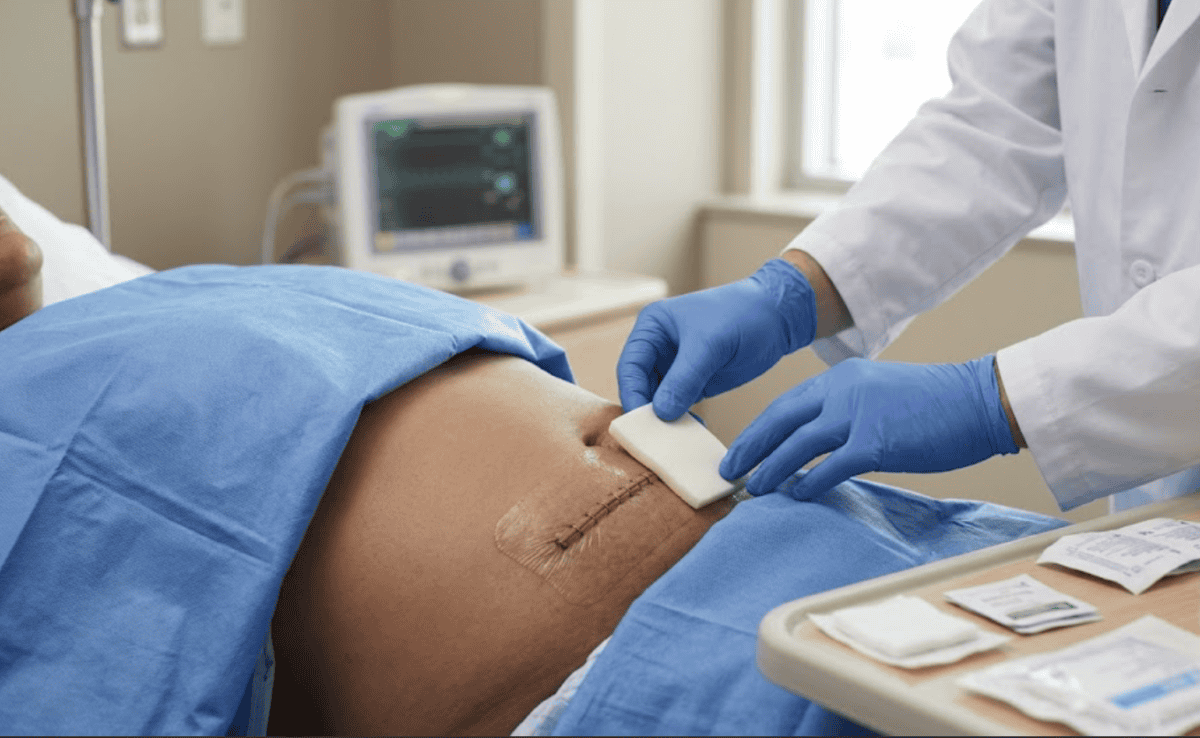
You closed the wound properly. The patient followed every instruction. Yet, days later, the edges pull apart.
Surgical wound dehiscence isn't a failure of skill; it’s a complication with identifiable risks and a structured path to resolution.
But effective surgical wound dehiscence management requires more than the basics. It demands rapid judgment, exact documentation, and knowing when advanced therapies genuinely serve the patient.
At RenewMed, we don't replace your judgment; we remove the administrative friction around it. We handle the insurance and logistics so you can focus on the patient.
Surgical wound dehiscence (SWD) is a high-stress complication that requires immediate action to prevent infection and evisceration. This surgical wound dehiscence management guide provides a clinical framework for assessment, decision-making, and the application of advanced biologics to restore wound integrity.
Wound disruption is most common between 5 and 10 days post-op. This is the "danger zone" where sutures are under maximum tension, but the wound hasn't yet developed enough tensile strength. However, it can still happen up to 30 days after.
Surgical wound dehiscence doesn't happen in a vacuum. It’s usually a collision of biology and physics.
Several factors drive this:
Tension is the most common enemy. Whether it’s from sutures tied too tightly, postoperative edema, or a patient’s sudden cough, the physical stress pulls the edges apart. Technical issues, like sutures removed too early or improper spacing, also play a role.
Infection doesn't just complicate a wound; it degrades the extracellular matrix and halts the inflammatory phase. If biofilm is present, your wound care protocol must prioritize debridement before any advanced therapy is considered.
Systemically, uncontrolled diabetes or poor peripheral perfusion can starve the incision of the oxygen required for wound healing.
When you identify breakdown, follow this clinical workflow to maintain momentum and prevent further complications.
Immediately assess the depth of the separation. If the fascial layer has breached and internal organs or surgical implants are visible (evisceration), this is a surgical emergency.
Cover the site with a sterile, saline-moistened dressing, keep the patient NPO (“nli per os" or “nothing by mouth”), and contact the operating surgeon immediately.
Look for the "classic" signs: purulence, foul odor, localized heat, or systemic fever. A "salmon-colored" serosanguinous discharge is often a precursor to fascial failure.
If infection is suspected, perform sharp debridement to remove necrotic debris and biofilm. Secure a wound culture to guide antibiotic therapy before the environment becomes too hostile for advanced healing.
Manage the patient’s glucose and protein intake. A patient in a catabolic state or with uncontrolled hyperglycemia can’t support the cellular migration needed for closure.
Make sure the patient’s blood glucose is controlled (ideally <180 mg/dL) and verify adequate protein intake (30–35 kcal/kg). Always keep an up to date Hgb A1c report in the chart.
Select an interactive dressing based on exudate levels. The goal is a moist environment.
Do a reassessment every 7 to 14 days. If the wound bed is granular and clean but the edges have failed to migrate (stalled) for more than two weeks, do not wait for a chronic ulcer to form. This is the "tipping point."
Contact your RenewMed consultant to initiate the documentation and authorization for an amniotic membrane graft.
When a patient presents with breakdown, your first goal is to rule out emergencies like evisceration. Your assessment must be systematic and decisive.
Use this framework to evaluate the biological state of the separation.
The 5 P's of Wound Care
If you don't see progress within the first 48 hours of "rescue" care, the risk of a secondary breakdown or deep-space infection rises significantly. This is where the 5 P's of wound care can help you rule out underlying vascular or neurological compromise that might be fueling the dehiscence.
Especially on the extremities, the 5 P's also help you rule out compartment syndrome or severe ischemia.
Not every dehisced wound needs a skin substitute. Should you pack it and wait, or graft it? This is the core tension in surgical wound dehiscence management.
Small wounds with clean beds and healthy edges often heal via secondary intention or delayed primary closure.
However, don’t wait 30 days on a wound that clearly won't respond.
|
Approach |
When to Choose |
The Risk |
|
Conservative Care |
Small separations (<1cm depth), healthy granulating base, no comorbidities. |
Slow closure, increased risk of biofilm buildup, and patient frustration. |
|
Advanced Biologics |
Full-thickness gaps, failure to progress after 2 weeks, high-risk patients (diabetes/obesity/chronic steroid use). |
Administrative burden (unless you have a partner like RenewMed). |
Don't wait for the wound to become chronic. General CMS and clinical guidelines state that if a wound hasn't shrunk by 50% within 4 weeks, it’s time to change the plan.
However, in surgical dehiscence management, you must act sooner to prevent the exposure of deeper structures like tendons or hardware.
Amniotic membrane grafts provide:
This is vital for surgical wounds where the native tissue is compromised or under tension.
RenewMed Tip: The 2026 CMS shift to a flat-rate payment of $127.14/cm² means precision is your best friend. Digital measurement and objective documentation aren't just for audits; they're how you ensure you're using the "minimum effective" graft size while staying profitable.
Medicare, and all other payers, are increasingly strict about why you chose an advanced graft over traditional dressing. They look for a "golden thread" of medical necessity.
More often than you realize, the difference between a paid claim and a denial comes down to a single sentence in your clinical note.
Add to this the time pressure you’re under, and you know your notes must be bulletproof.
Most surgeries carry a 10- or 90-day global period. Typically, the payment for the initial surgery includes "routine" post-op care.
However, if a dehiscence requires an advanced procedure, like applying a skin substitute, you must document this as a "separately identifiable" service.
RenewMed’s White Glove Service includes guidance on these specific documentation cues.
Reach out to our consultants to find out how we can help you meet the latest CMS standards.
How many days after surgery is dehiscence most common?
It’s most frequent between 5 and 10 days post-op. This is the period where the initial surgical seal is weakest before long-term collagen has formed.
How do you treat surgical wound dehiscence with biologics?
Biologic grafts, like amniotic membranes, are applied directly to the wound bed after proper debridement. They provide wound covering and a scaffold that helps the body close the gap faster than traditional dressings alone.
What is the "Rule of 48" in dehiscence?
While not a formal staging rule, many surgeons follow a "48-hour watch" after a small separation. If the wound shows any increase in size or exudate within 48 hours, it's a trigger for aggressive intervention rather than "watchful waiting."
What is the difference between dehiscence and evisceration?
Dehiscence is the separation of the wound layers. Evisceration is a medical emergency where the internal organs (viscera) protrude through the separated incision.
Does Medicare cover amniotic grafts for all surgical wounds?
Coverage depends on the specific LCD (Local Coverage Determination). Generally, the wound must be "chronic" (stalled for 30 days) OR be a complex surgical site where standard care is insufficient.
How does RenewMed help with global period billing?
We have relationships to assist with how to document complications so they are recognized as "non-routine." This helps you protect your revenue while providing the advanced care the patient needs.
Don't let a surgical complication stall your patient's recovery or your practice's workflow.
Every wound tells a story. Let's write better endings—together.
Sources used:
Disclaimer: This content is created for licensed healthcare professionals, offering educational insights into wound care. It is not intended as medical advice or to replace your own clinical judgment when treating patients. We're here to support you, but the final treatment decisions should always be based on your professional evaluation of each unique patient's needs.
