When To Switch To Advanced Chronic Wound Treatment Solutions

Wound care for a patient who isn't healing is one of the most frustrating aspects of clinical practice. That’s why advanced chronic wound treatment solutions are becoming the new standard for cases where conservative care stalls.

For many providers, the "standard of care" (SOC)—debridement, offloading, infection control, and moist dressings—works well for acute injuries. However, chronic wounds operate under a different set of biological rules.

When a wound remains open for more than 30 days, it enters a state of chaotic inflammation that standard dressings simply cannot fix. To understand why, we must look at the cellular mechanisms that cause traditional methods to fail and how modern therapies restart the healing process.


Why Traditional Wound Care Is Not Enough

Traditional wound care relies heavily on the body’s innate ability to heal. The goal of standard dressings is primarily protective. They cover the wound, manage exudate, and create a moist environment.

This passive approach assumes the patient’s cellular machinery is functioning correctly. In a healthy patient with an acute injury, this is a safe assumption.

However, in the Medicare demographic, often dealing with diabetes, venous insufficiency, or arterial disease, the cellular machinery is broken.

A standard alginate or foam dressing doesn’t actively correct the biological environment. It merely maintains the status quo. If the underlying tissue is stuck in a chronic inflammatory cycle, "maintaining" the wound stagnates instead of closing.


Stalled Healing at a Cellular Level

To understand why advanced chronic wound treatment solutions are necessary, we must look at what’s happening microscopically in a non-healing wound.

A chronic wound is biologically distinct from an acute wound. It’s characterized by a hostile microenvironment that actively destroys healing tissue.

The Protease Imbalance

Chronic wounds tend to have higher levels of Matrix Metalloproteinases (MMPs). While MMPs are necessary for clearing out damaged tissue in the early stages of healing, they become destructive when unregulated.

In a chronic wound, excess MMPs digest growth factors and new extracellular matrix (ECM) as fast as the body produces them.

Growth Factor Deficiency

In a healthy wound, growth factors act as the "general contractors," signaling cells to build new tissue.

In chronic wounds, these signals are either absent or degraded by proteases. Without these active signals, the repair process grinds to a halt.

Senescent Cells

Also called "zombie cells," these cells are metabolically active but have stopped dividing. They build up in chronic wounds and release pro-inflammatory cytokines. This fuels inflammation and prevents the transfer of healthy keratinocytes and fibroblasts.

Biofilm Formation

Bacteria in chronic wounds form a biofilm. It’s a protective slime layer that makes them resistant to systemic antibiotics and immune responses.

It’s rare for standard dressings to breach this barrier effectively.

When you apply a standard dressing to this environment, you’re essentially putting a bandage over a biological war zone. To change the equation, you need advanced therapies.


What Are Advanced Chronic Wound Treatment Solutions?

Advanced chronic wound treatment solutions refer to active therapies designed to interact with the wound bed to stimulate closure.

Unlike passive dressings, these products, specifically skin substitute grafts or amniotic membrane grafts, bring biological structure to the wound. These are made from human placental tissue (amniotic membrane). The placental membrane is rich in native extracellular matrix proteins, growth factors, and cytokines.

These solutions cover the wound and help shift the wound from a chronic, inflammatory state to an acute, proliferative state.


How These Solutions Improve Healing Outcomes

1. Scaffolding for Cell Migration

The extracellular matrix (ECM) in amniotic grafts serves as a scaffold. It gives the patient’s own cells a structure to climb across, bridging the gap that the body couldn’t close on its own.

2. Modulation of Inflammation

Advanced grafts contain natural properties that help soothe the excessive inflammatory response. By reducing inflammation, the wound can finally move into the remodeling phase.

3. Replenishment and Protection of Growth Factors

These grafts do more than just cover the wound; they’re biologically active. They deliver the native growth factors that chronic wounds lack, signaling the body to heal.

At the same time, the robust matrix protects these factors from being immediately destroyed by excessive MMPs.


Comparison: Traditional vs. Advanced Wound Care
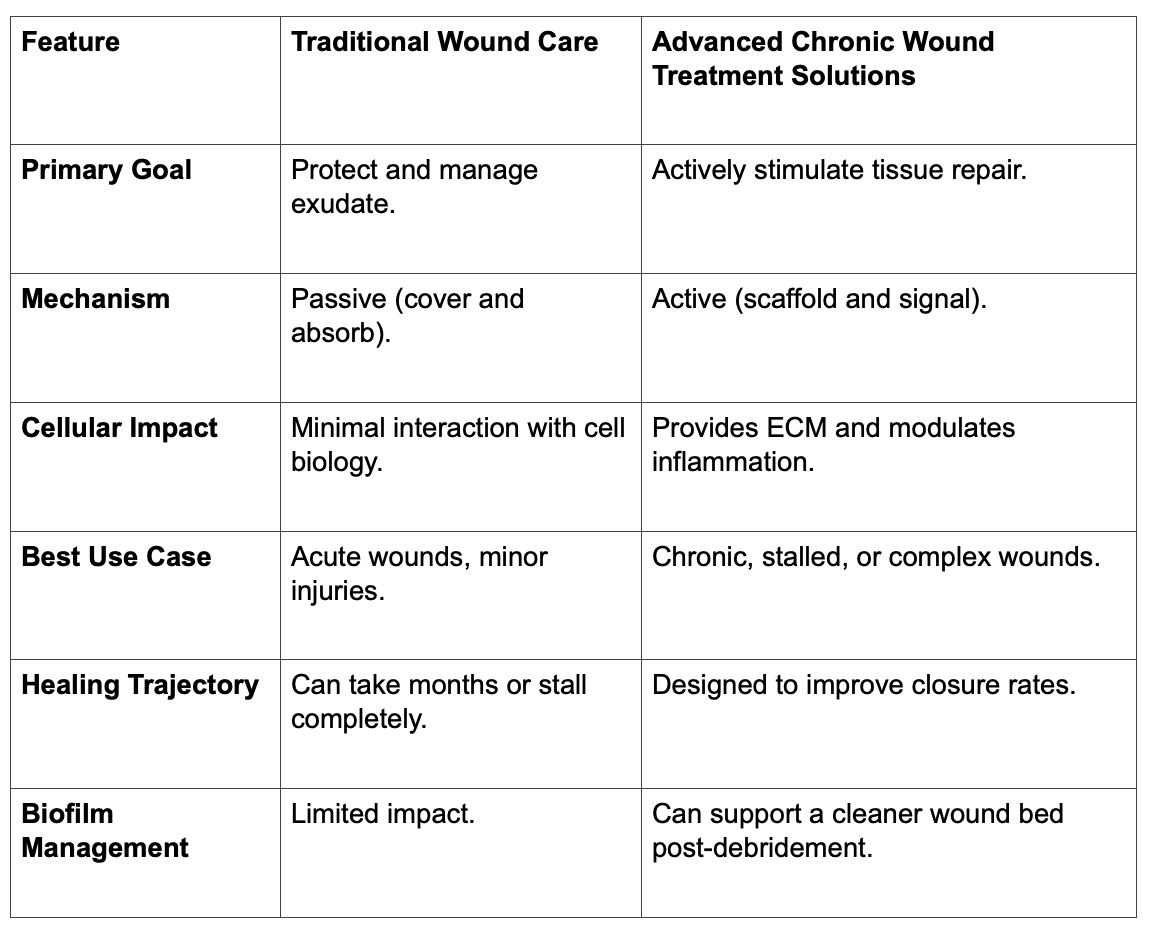
treatment wound comparison

When to Implement Advanced Solutions

Knowing when to switch strategies is critical for both patient outcomes and practice efficiency.

You should consider advanced chronic wound treatment solutions when:

Waiting too long to escalate care increases the risk of infection, hospitalization, and even amputation. Early intervention with the right biologic can prevent these drastic outcomes.


Your Partner in Advanced Healing

Adopting advanced chronic wound treatment solutions is a clinical upgrade. But we know it presents administrative challenges. Many providers hesitate because of the paperwork, the fear of reimbursement clawbacks, or the complexity of ordering biologics.

This is where RenewMed steps in. We’re your White Glove Service partner, integrating the entire process into your practice.

We Handle the Heavy Lifting

We manage the product logistics, so you can focus on patient care.


Frequently Asked Questions (FAQs)

Are these advanced treatments covered by Medicare?

Yes, generally. Medicare covers specific advanced skin substitutes to treat chronic wounds, like Diabetic Foot Ulcers (DFUs) and Venous Leg Ulcers (VLUs). However, standard care must have failed, and the needed documentation requirements must have been met.

How do I know which graft size to order?

We assist with this. Grafts come in various sizes (measured in square centimeters). Minimizing waste is important for compliance and cost. Our team helps you match the product inventory to your patient needs.

Is the application process difficult?

No. Applying an amniotic graft is straightforward and can be done in the office setting. It typically involves:

  1. Debriding the wound.
  2. Placing the graft.
  3. Covering it with a non-adherent dressing.

How quickly will I see results?

While every patient is different, many clinicians report seeing positive changes in the wound bed within weeks of the first application.

Do I need to store these products in a special freezer?

It depends on the specific product line. Some are cryopreserved and require specific low-temperature storage. Others are dehydrated and shelf-stable at room temperature.

We help you choose the option that fits your facility’s capabilities.


Achieving Predictable Outcomes

Stalled wounds don’t have to remain that way. Advanced chronic wound treatment solutions provide the biological boost necessary to overcome the cellular limitations of chronic wounds.

Integrating these therapies into your practice protects your patients from prolonged suffering and sets your clinic apart as a leader in wound care.

Let’s discuss how we can support your practice.

Contact our team today.

Advance your clinical potential. Partnering for better outcomes, every single day.


Sources Used

  1. https://pubmed.ncbi.nlm.nih.gov/12766127/
  2. https://pmc.ncbi.nlm.nih.gov/articles/PMC3623589/
  3. https://www.magonlinelibrary.com/doi/abs/10.12968/jowc.2017.26.1.20
  4. https://www.frontiersin.org/journals/cell-and-developmental-biology/articles/10.3389/fcell.2020.00773/full
  5. https://onlinelibrary.wiley.com/doi/10.1111/iwj.12140


Disclaimer: This content is created for licensed healthcare professionals, offering educational insights into wound care. It is not intended as medical advice or to replace your own clinical judgment when treating patients. We're here to support you, but the final treatment decisions should always be based on your professional evaluation of each unique patient's needs.

Why Traditional Chronic Wound Treatment Is Not Enough

A chronic wound isn’t just a slow-healing injury or a wound that won’t heal. For millions of Medicare patients, it threatens their independence. For you, the provider, chronic wound treatment represents a complex clinical challenge.

When standard dressings and basic debridement fail to produce results, sticking to the status quo isn't an option.

To improve outcomes, we have to understand why traditional care stops working and how modern biologics can restart the healing process.


Why Standard Chronic Wound Treatment Stalls

Standard of Care (SOC) usually involves moist wound therapy, debridement, and infection control. While this works for acute (fresh) wounds, SOC often falls short for chronic cases. The reason lies in the molecular environment of the wound.

These wounds often get stuck in a chaotic state of inflammation. High levels of enzymes called matrix metalloproteinases (MMPs) eat away at growth factors and essential proteins faster than the body can make them.

On top of that, biofilm is present in all chronic wounds. Without effective debridement, this bacterial shield makes many topical treatments useless and prevents healing.

Before you can treat the wound effectively, you must break these barriers. And basic dressings cannot fix these underlying biological issues.

Innovative Biologic Solutions

When a wound stalls, it needs a wake-up call. This is where advanced chronic wound treatment using biologic skin substitutes makes a difference.

Unlike passive dressings that just cover the area, these products are active healing participants.

How Biologics Improve Treatment

● Bioactive Matrix. It rebuilds the frame (extracellular matrix), giving cells a fresh scaffold to climb and grow on.

● Growth Factor Delivery. They bring in essential signaling molecules that chronic wounds are missing.

● Recruiting Stem Cells. They signal the body’s own stem cells to come to the injury site and start repairing.

Switching to a biologic approach helps turn a stalled, chronic environment into an acute, healing one.

Benefits for Your Patients and Practice

Shifting to advanced modalities offers clear benefits. Studies show that using cellular and tissue-based products (CTPs) significantly increases the percentage of wounds that close completely.

For your patient, effective chronic wound treatment means less pain, better mobility, and a lower risk of severe complications like bone infection or amputation.

For your practice, it means treating patients more effectively, freeing up your schedule, and providing a higher standard of care.

Supporting Your Treatment Protocols

The admin of adopting advanced therapies can be overwhelming. Insurance pre-authorizations, product ordering, and billing rules often stop providers from using the best tools available. RenewMed exists to solve this problem. We’re your distributor and support, streamlining the business side of wound care.

Our White Glove Service:

● Assigns a Personal Consultant to your practice to manage the logistics.

● Handles the Insurance Verification Requests (IVR) to ensure patient eligibility.

● Provides the documentation templates you need to prove medical necessity.

● Ensures our products are on the Medicare Average Sales Price (ASP) list, for a smoother, faster reimbursement for your practice.

By managing the 'business' of medicine, we let you focus entirely on the 'practice' of medicine.

Frequently Asked Questions

What is a chronic wound?

It is a wound that has not healed or significantly improved after 30 days of standard care.

What is the main cause of chronic wounds?

Poor blood flow, diabetes, and prolonged pressure are the most common causes. These issues stop the natural healing process.

How does biofilm affect chronic wound treatment?

Biofilm acts like a shield for bacteria, protecting them from antibiotics and the immune system. This keeps the wound inflamed and prevents healing.

When should I switch to advanced products?

If you don't see the wound shrink by about 50% after 4 weeks of optimal standard care, it's time to look at advanced therapies.

Does RenewMed help with product selection?

Yes. We offer a portfolio of products and can provide clinical information to help you select the best graft for the specific wound type.

Does RenewMed help with insurance appeals?

Yes. Our billing partners specialize in wound care. They can help you manage claims and appeals to protect your revenue.

Is reimbursement difficult for these treatments?

It can be tricky. However, our White Glove Service includes access to billing partners who help with claims and appeals.


Upgrade Your Standard of Care

Effective chronic wound treatment means using better tools when basic care fails. By using advanced biologics and a partner who handles the administrative burden, you ensure your patients get the best chance to heal. CTA: Reach out to RenewMed today. We’ll help you stop managing wounds and start healing them.

Advance your health. Empowering providers, healing patients.


Sources Used 1. https://www.mdpi.com/2077-0383/14/22/8121 2. https://pmc.ncbi.nlm.nih.gov/articles/PMC5426882/ 3. https://woundsinternational.com/wp-content/uploads/2024/12/MULTI24_CD_Skin-substitues_WINT_WEB.pdf 4. https://pubmed.ncbi.nlm.nih.gov/39841083/ 5. https://www.cms.gov/Medicare/Coverage/DeterminationProcess/downloads/id109TA.pdf


Disclaimer: This content is created for licensed healthcare professionals, offering educational insights into wound care. It is not intended as medical advice or to replace your own clinical judgment when treating patients. We're here to support you, but the final treatment decisions should always be based on your professional evaluation of each unique patient's needs.

How to Treat Arterial vs. Venous Ulcers Effectively

Two patients present with lower leg ulcers. At a glance, the wounds seem similar, but the underlying causes of arterial and venous ulcers are complete opposites.

One is caused by a blood flow "delivery" problem (ischemia), the other by a "return" problem (venous hypertension).

This distinction is critical. The best treatment for one is harmful to the other. Getting the diagnosis right from the start is the most important step toward wound healing.


Arterial vs. Venous Ulcers: Know the Difference

Accurate identification begins with understanding what causes each type of ulcer and knowing the distinct signs they present.


Venous Ulcers: A "Return" Problem

Venous ulcers are the most common type of leg ulcer.

They happen when the valves in a patient's leg veins fail to work correctly, a condition known as venous hypertension. This causes blood to pool in the lower legs, increasing pressure and breaking down the skin.


Characteristics

● Location. Typically found in the "gaiter area," between the ankle and the knee.

● Appearance. Often large and shallow with irregular borders.

● Drainage. Usually have moderate to heavy fluid drainage or exudate.

● Surrounding Skin. The skin may be swollen and have a brownish discoloration from iron deposits (hemosiderin staining) or show signs of hardening (lipodermatosclerosis).

● Pain. Discomfort often improves when the legs are elevated.

● Physical Exam. Pedal pulses are typically present and palpable.

● Patient History. Often associated with a history of Deep Vein Thrombosis (DVT), obesity, or jobs involving prolonged standing.


Arterial Ulcers: A "Delivery" Problem

Arterial ulcers are caused by poor circulation from blocked or narrowed arteries, a condition called ischemia. This is often due to peripheral arterial disease (PAD).

The tissue simply doesn't get enough oxygen-rich blood to survive, and an ulcer forms.


Characteristics

● Location. Often appear on the feet, heels, tips of toes, or between the toes, where circulation is poorest.

● Appearance. Tend to have a "punched-out" look, appearing deep with well-defined, even borders. The wound bed itself is often pale, gray, or yellow with little to no drainage.

● Surrounding Skin. The skin may be cool to the touch, shiny, and hairless. Patients often report severe pain, especially at night or when their legs are elevated.

● Pain. Pain is often severe, especially at night (rest pain) or when the legs are elevated. It may be relieved by dangling the feet over the side of the bed.

● Physical Exam. Pedal pulses (dorsalis pedis and posterior tibial) are often weak or absent. The toes will have a long capillary refill time.

● Patient History. Patients may report cramping pain in the calf during exertion (intermittent claudication). Risk factors include smoking, diabetes, high cholesterol, and hypertension.


Why an Accurate Diagnosis Is Crucial

The causes of arterial vs. venous ulcers are significantly different, which means their treatments are too. An incorrect diagnosis can lead to a therapy that makes the wound worse.

For example, the cornerstone of venous ulcer treatment is compression.

However, applying compression to an arterial ulcer is extremely dangerous. It would further restrict already poor blood flow and could lead to tissue death and potential amputation.

Using a diagnostic tool like the Ankle-Brachial Index (ABI) is crucial to assess blood flow and confirm the diagnosis before starting any treatment.

● An ABI result of less than 0.9 suggests PAD.

● A result below 0.5 indicates severe disease. Do NOT use compression.

● An ABI between 0.8 and 1.4 generally shows that compression is safe.


Contrasting Treatment Approaches for Arterial vs. Venous Ulcers

Once you have an accurate diagnosis, the treatment paths become clear and distinct.


Treating Venous Ulcers

The primary goal is to manage the underlying venous hypertension. This is achieved mainly through compression therapy, which helps the veins push blood back toward the heart.

Treatment also involves elevating the legs and using dressings that can effectively absorb heavy drainage to protect the surrounding skin.


Treating Arterial Ulcers

Here, the focus is entirely on restoring blood flow to the area. This often requires a referral to a vascular specialist for procedures that can open the blocked arteries (revascularization).

Compression therapy should never be used unless under specific guidance.

Wound dressings are chosen to keep the wound moist and protected without putting any pressure on the limb.

Patients will also have to make lifestyle changes, quitting smoking and managing risk factors like diabetes and high blood pressure.


The "Third" Diagnosis: Mixed-Aetiology Ulcers

Unfortunately, many patients don't fit neatly into one category. A significant number of patients (about 20%) have both venous and arterial disease present.

This diagnosis requires a careful balancing act. It can involve modified or reduced compression under expert management to avoid compromising arterial supply.


Advanced Solutions for Complex Chronic Wounds

Addressing the underlying cause is the first step. Yet, some chronic arterial and venous ulcers still struggle to close and require advanced support. That's where RenewMed helps. We're a national distributor of the highest quality skin substitute grafts.

These advanced products provide a scaffold for the body's own cells to build new tissue, which is essential for healing complex wounds. Our team understands the nuances of arterial vs. venous ulcers and helps you choose the right product for each specific condition.

We also offer a White Glove Service to handle the admin.

It's a full-service support system designed to handle the administrative and financial complexities. Your dedicated consultant manages insurance verifications, ordering, and partners with billing experts for timely payments.

Now you can focus on patient outcomes while we handle the rest.


Let's talk about advancing your health care.

Together, we can make a difference, one patient at a time.


Sources Used 1. https://geekymedics.com/leg-ulcers/ 2. https://blog.wcei.net/venous-ulcers-vs-arterial-ulcers 3. https://pmc.ncbi.nlm.nih.gov/articles/PMC1363917/ 4. https://www.healogics.com/wound-care-patient-information/arterial-venous-ulcers/ 5. https://www.medicalnewstoday.com/articles/arterial-vs-venous-ulcers 6. https://med.stanford.edu/stanfordmedicine25/the25/ankle-brachial-index.html


Disclaimer: This content is created for licensed healthcare professionals, offering educational insights into wound care. It is not intended as medical advice or to replace your own clinical judgment when treating patients. We're here to support you, but the final treatment decisions should always be based on your professional evaluation of each unique patient's needs.

How Diabetic Wound Healing Ointment Supports Faster Recovery

It's a familiar challenge in wound care: a diabetic ulcer that refuses to heal.

Despite consistent debridement (removal of damaged tissue) and standard protocols, the wound remains stalled week after week. This scenario highlights a critical need for specialized tools designed for the unique physiology of diabetic patients. A targeted diabetic wound-healing ointment is one of those essential tools. It helps create an environment that supports the body's compromised healing process.


Why Diabetic Wounds Demand Specialized Care

Treating a diabetic wound is different from managing an acute injury. Several underlying factors are actively working against the healing process.

● Hyperglycemia (high blood sugar) makes it harder for the patient's white blood cells to fight off infection. It also compromises the body's ability to manage bacteria effectively.

● On top of that, poor circulation means less oxygen and fewer nutrients make it to the wound.

● Neuropathy (nerve damage) can also prevent patients from noticing an injury until it's severe.

Together, these issues stall healing. They often lead to chronic inflammation and a wound that stays open and vulnerable for more than 30 days.


What Is a Diabetic Wound-Healing Ointment?

A diabetic wound-healing ointment is created specifically for these challenges. It's not your standard over-the-counter antibiotic ointment for general lacerations.

Instead, it manages a chronic wound's environment for optimal healing.

This means it controls moisture levels, reduces the bacterial load, and soothes inflammation. The right ointment works with the body. It helps a stalled wound get back on its healing course.

Diabetic wound-healing ointment is an integral part of any comprehensive wound care strategy.


Benefits of Using Diabetic Wound-Healing Ointments

Using the correct ointment gives your patients distinct advantages, especially as each benefit can solve a common chronic diabetic ulcer recovery roadblock.

It Helps Soothe Inflammation

Chronic wounds are often stuck in a prolonged inflammatory phase. A quality diabetic wound-healing ointment has ingredients that help soothe inflammation. This lets the wound move into the tissue-building phase of healing.

It Keeps the Wound Moisture Balanced

Proper moisture control is vital for wound healing. A wound bed must be moist, but not wet, to heal properly.

● If it's too dry, new cells can't move across the surface.

● Too wet, however, can lead to maceration (breakdown) of the surrounding skin.

A quality ointment helps maintain the perfect moisture balance needed for recovery.


It Fights Harmful Bacterial Biofilm

All chronic wounds contain biofilm. It's the main reason they don't heal.

Many specialized ointments have antimicrobial properties. These properties help reduce the bacteria and disrupt the biofilm without harming the healthy, new tissue.

It Can Stimulate Tissue Regeneration

Some advanced formulas contain ingredients that support the body's own cell activity. This helps encourage new tissue to form, which is precisely what you need to close the wound.


Choosing a High-Quality Diabetic Wound-Healing Ointment

You have to carefully review the formula before selecting a product. Some ingredients are unnecessary, and others can cause more harm than good.


 What Your Patients Need in an Ointment

● Evidence-based ingredients. You want components that have solid data to back up their use in wound care.

● Antimicrobial properties. It should help manage bacteria without harming the wound bed.

● Moisture regulation. It must be able to add moisture to a dry wound or absorb fluid from a wet one.

● A gentle, non-irritating base. Make sure it's free of common allergens that could cause more skin issues.


What to Avoid in Ointment Formulations

● Harsh chemicals. Steer clear of ingredients like hydrogen peroxide or alcohol that can be toxic to new cells.

● Fragrances or dyes. These don't add any healing benefit and can easily irritate the skin.

● Common allergens. Always be mindful of ingredients that could trigger a contact dermatitis reaction.

● Drying agents. Avoid anything that could dehydrate the wound bed and stop the healing process.


Comprehensive Solutions for Advanced Healing

A diabetic wound-healing ointment is a fundamental tool. But some chronic wounds might need a more advanced solution to close fully. RenewMed specializes in supplying state-of-the-art wound care treatments. We're a national distributor of the best-in-class skin substitute grafts.

These bioengineered products give the body a scaffold to build new tissue and heal the wound. We know that bringing new treatments into your practice can be complex, which is why we created our White Glove Service.

It's a full-service support system that removes the administrative and financial headaches.

Your dedicated consultant handles the insurance verifications, prior authorizations, and ordering. We also have expert billing partners to help with documentation, so you get timely payments.

Our service lets you advance your health care. You focus on your patient; we handle the rest. H4: Contact us today to learn more.

Together, we can make a difference, one patient at a time.


Sources Used 1. https://pmc.ncbi.nlm.nih.gov/articles/PMC5875034/ 2. https://www.medicalnewstoday.com/articles/320739 3. https://pmc.ncbi.nlm.nih.gov/articles/PMC8568799/ 4. https://eurjmedres.biomedcentral.com/articles/10.1186/s40001-023-01121-7 5. https://www.hmpgloballearningnetwork.com/site/wounds/article/1585


Disclaimer: This content is created for licensed healthcare professionals, offering educational insights into wound care. It is not intended as medical advice or to replace your own clinical judgment when treating patients. We're here to support you, but the final treatment decisions should always be based on your professional evaluation of each unique patient's needs.