
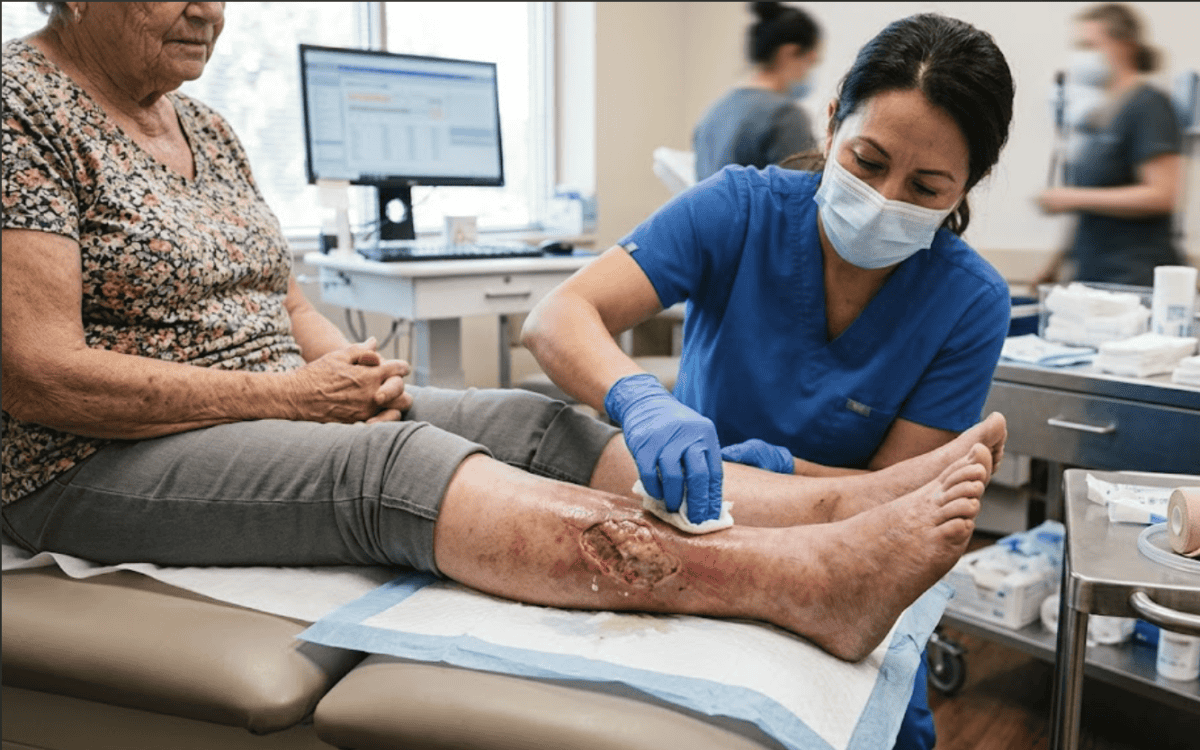
You’ve debrided the wound. You’ve addressed the moisture. You’ve offloaded the pressure. Yet, week after week, the wound sits there, neither getting worse nor showing progress.
This is the clinical frustration that biofilm creates. It’s a problem hiding in plain sight.
Effective biofilm management in chronic wounds requires us to acknowledge a tough truth: Traditional protocols often fail because they don't account for microbial communities actively sabotaging the healing process.
Research suggests biofilm is present in up to 90% of chronic wounds. It isn't the exception; it's the rule.
To win this fight, you need a plan that goes beyond surface cleaning. Using advanced biologics and disruption tools is the only way to break the siege.
H3: Our Clinical Snapshot
Biofilm is a microscopic fortress that protects bacteria from the immune system and antibiotics. This biofilm management in chronic wounds guide outlines how to detect this invisible barrier and use a multi-step disruption strategy to restart the healing process.
H3: Essential Takeaways
Explore the "fortress" biology of how biofilm prevents wound closure.
A framework for clinical detection when visible signs are absent.
Why serial debridement is a non-negotiable standard.
Synergizing antimicrobial dressings with amniotic biologics.
H2: What Is Biofilm and Why Does It Matter in Wound Care
Biofilm isn't a group of bacteria living in a wound. It’s a highly organized and sophisticated microbial city. Within hours of an injury, planktonic (free-floating) bacteria attach to the wound bed and begin secreting a "slime" called Extracellular Polymeric Substance (EPS).
This EPS matrix is the reason why biofilm management in chronic wounds is so difficult. In fact, biofilm-protected bacteria can be 1,000 times more resistant to treatment than free-floating bacteria.
Antibiotic Shield: The matrix is physically too thick for most topical or systemic antibiotics to penetrate.
Immune Evasion: It "cloaks" the bacteria from white blood cells, meaning the body’s natural defenses can't see the target.
Chronic Inflammation: The presence of biofilm keeps the wound "stuck" in the inflammatory phase, preventing the transition to the proliferative (healing) phase.
H3: Why Healing Stalls
Biofilm triggers a perpetual inflammatory phase. The body keeps sending neutrophils to fight, but they can't penetrate the EPS matrix.
Instead, they release proteases that accidentally break down the growth factors and healthy tissue your patient needs for closure. It’s a destructive cycle that standard dressings simply can't break.
H2: Clinical Signs Suggesting Biofilm Presence
You can't see biofilm with the naked eye, and standard swabs rarely capture the full picture. However, you can look for clinical "red flags."
The Shiny Slime: A persistent, glossy, or translucent film on the wound surface.
The 48-Hour Reform: If you clean the wound and it looks "clean," but that same slimy layer returns within 1-2 days, you’re looking at a mature biofilm.
Failure to Respond: If the wound hasn't shrunk by 20% in four weeks despite standard care, biofilm is likely the culprit.
Odors and Slough: Persistent malodor or a constant return of stringy slough despite frequent debridement.
Poor Quality Granulation: Tissue that is friable (bleeds easily), dusky red, or "bubbly" is a classic sign of a high bacterial load hiding in a matrix.
Recurrent Infection: The wound looks better on antibiotics but regresses the moment the script ends.
If a wound is chronic, assume biofilm is there. Expert consensus now supports treating for biofilm by default rather than waiting for proof.
H2: Brief Biofilm Management in Chronic Wounds Reference Guide
Because biofilm can begin to reform within hours of treatment, your protocol must be aggressive and timed perfectly.
Step 1: Mechanical Disruption. Use sharp debridement to physically break the EPS "shield." This is the only way to expose the bacteria.
Step 2: Aggressive Irrigation. Flush the area with a surfactant-based wound cleanser to lift away microscopic debris that a curette might miss.
Step 3: Immediate Suppression. Apply a high-potency antimicrobial (like silver or iodine-based dressings) for the first 24 to 72 hours post-debridement to kill the now-exposed bacteria.
Step 4: Moisture Control. Use dressings that wick away excess exudate, as the fluid produced by biofilm-burdened wounds is often high in destructive proteases (MMPs).
Step 5: Biological Reset. Once the biofilm is suppressed and the wound bed is clean, layer an amniotic membrane on the wound bed to prevent re-colonization and kickstart the healing cascade.
H2: Mechanical Disruption: Debridement Strategies
You cannot "soak" away a biofilm. You have to physically tear it down. This is the first and most vital step in biofilm management in chronic wounds.
Sharp Debridement: Use a curette or scalpel to physically remove the top layer of the wound bed. This removes dead tissue, "breaks the "bunker," and exposes the vulnerable bacteria underneath.
Mechanical Cleansing: Using textured pads or high-pressure irrigation (4-15 psi) during every dressing change.
Frequency Matters: Biofilm begins to reform within minutes and becomes fully mature in 2 to 3 days. This is why "sporadic" debridement fails. To be effective, disruption must be frequent and aggressive, once to twice per week.
H3: Antimicrobial Dressings
Once you’ve breached the EPS matrix through debridement, you have a "window of opportunity" (usually 24-48 hours) where the bacteria are vulnerable. This is when you "cover" the wound with an antimicrobial agent.
Effective choices include:
Silver-based dressings: Disrupt the bacterial cell wall once the matrix is open.
Cadexomer Iodine: Highly effective at absorbing exudate and physically breaking down the EPS matrix.
PHMB or Hypochlorous Acid: Powerful cleansers that help prevent the "slurping up" of new bacteria into a new biofilm.
H2: When to Consider Advanced Biologics
The ultimate goal of biofilm management in chronic wounds is to close the wound. Once the biofilm is managed and the wound bed is "quiet" (low inflammation and clean granulation), you have a prime opportunity to apply an amniotic membrane graft.
Amniotic tissues contain anti-inflammatory cytokines that help quiet the "cytokine storm" caused by chronic biofilm presence. By introducing these growth factors into a freshly debrided wound, you’re essentially giving the body the instructions it needs to close the wound before the bacteria can reorganize.
RenewMed Tip: Documentation of biofilm management is a major "justification" for advanced biologics. If you can show that you’ve managed the bioburden but the wound remains stalled, Medicare is much more likely to approve an amniotic graft claim.
H3: Break the Cycle
Biofilm management requires a relentless cycle of "Disrupt, Clean, and Protect." By partnering with RenewMed, you gain access to the clinical expertise and advanced therapies needed to finally win the battle against non-healing wounds.
Contact us today to find out how we can remove your advanced wound care administration hurdles.
H2: Common Questions About Biofilm Management in Wound Care
Why does biofilm come back so fast?
Bacteria within a biofilm can go into a "dormant" state where they don't divide. Most treatments target actively dividing bacteria. Once the treatment ends, the dormant bacteria "wake up" and start rebuilding the EPS matrix immediately.
Is slough the same thing as biofilm?
No. Slough is a collection of dead cells, fibrin, and debris. While biofilm often lives within slough, you can have biofilm on a wound that looks completely clean to the naked eye.
Can a non-healing wound have a biofilm present?
Yes. Research suggests that up to 90% of all chronic, non-healing wounds contain a biofilm. It is considered the single most common reason why wounds fail to progress through the normal stages of healing.
Unlike an acute infection (cellulitis), where the bacteria are "free-floating" and easy to target, biofilm bacteria are sedentary and resistant. They keep the wound in a permanent "stall," consuming the body's resources without ever allowing the proliferative phase to begin.
What kills biofilm naturally?
While some natural agents like medical-grade honey (Leptospermum) have shown the ability to disrupt biofilm, clinical "biofilm management" usually requires a combination of physical debridement and medical-grade antimicrobials to ensure total matrix breakdown.
How often should biofilm be disrupted?
Because biofilm begins to reform almost immediately, it should be disrupted at every single dressing change. Professional debridement should be performed at least weekly until the wound shows consistent signs of closure.
Why don't oral antibiotics work on biofilm?
Oral antibiotics cannot penetrate the EPS matrix in high enough concentrations to kill the bacteria, making topical disruption necessary.
Does insurance cover the surfactants used for biofilm?
Coverage varies, but most of these are considered "supplies" under the global surgical package or the office visit. We can help you review your specific MAC’s rules for 2026.
H3: Move Toward Closure
Stop letting invisible barriers hold back your patient’s progress. Join us in making a difference by removing the friction from the wound bed and your clinical workflow.
CTA BUTTON: Contact a RenewMed Consultant Today
Join us in breaking the barriers to healing, one patient at a time.
Sources used:
https://www.researchgate.net/publication/397228756_Biofilms_and_Chronic_Wounds_Pathogenesis_and_Treatment_Options
https://pmc.ncbi.nlm.nih.gov/articles/PMC12583926/
Autolytic continuous debridement with a focus on biofilm management
https://pmc.ncbi.nlm.nih.gov/articles/PMC10117668/
Disclaimer: This content is created for licensed healthcare professionals, offering educational insights into wound care. It is not intended as medical advice or to replace your own clinical judgment when treating patients. We're here to support you, but the final treatment decisions should always be based on your professional evaluation of each unique patient's needs.
