

Not all chronic wounds with bacteria need to wait for grafts, but many do. Understanding colonization vs. infection protects you from costly mistakes. Applying a skin substitute to an infected wound wastes product, delays healing, and often triggers claim denial. This guide covers the infection severity ladder, payer documentation requirements, and when to delay advanced therapy.
Applying a skin substitute to an infected wound doesn't just waste money. It delays healing and may trigger claim denial.
Yet infection-related graft failures remain a common documentation mistake in wound care. Why? The line between colonization (normal) and infection (requires intervention) isn't always clear, and payers scrutinize this distinction extensively.
Chronic wound infection management requires clinical judgment, not absolute rules. Some products have antimicrobial properties. But in most cases, documented infection clearance is non-negotiable before advanced treatment.
That’s why this blog shows when to wait and how to document it.
The complicated nature of wound care claims leads to an average denial rate of about 15% to 30%. About 40% of those stem from insufficient documentation. Claims for chronic wounds with infection status sit at the center.
Under Medicare’s 2026 model, skin substitutes are reimbursed at a flat rate of $127.14 per square centimeter, with no wastage reimbursement. If you apply the biologic too early and it fails, you absorb the cost.
Infection documentation isn't just for clinical records but also for financial security.
All chronic wounds contain bacteria. When the bacteria doesn’t trigger an immune response, it’s colonization. It's expected and doesn’t necessarily delay the use of skin grafts.
The wound infection continuum helps you identify severity. Here's how to assess, document, and respond.
Clinical signs: No pain increase, warmth, or erythema. Wound progressing normally. Drainage is clear to serosanguinous. No unusual odor.
Lab values: Bacterial counts < 100,000/cm².
Treatment: None needed.
Documentation: "Wound bed shows healthy granulation with no clinical signs of infection. No contraindications related to infection observed."
Graft decision: Typically yes. Colonization alone doesn't delay therapy.
Clinical signs (3 or more): Increased pain. Erythema beyond wound edges. Purulent drainage or exudate spike. Friable, pale tissue. Wound enlarging despite care. New or worsening odor.
Lab values: Bacterial counts may exceed 100,000/cm². Localized CRP/ESR elevation possible.
Treatment: Aggressive debridement, topical antimicrobials, possibly short-course oral antibiotics if topicals are insufficient.
Documentation: "Wound exhibits clinical signs of localized infection, including [list signs]. Initiated [treatment]. Plan: Reassess in [X days] for infection clearance before considering advanced therapy."
Graft decision: In most cases, wait for documented clearance.
Clinical signs: Red streaking. Fever, chills. Tachycardia, hypotension. High white blood cell (WBC) count. Positive blood cultures.
Lab values: WBC > 12,000 or < 4,000. Positive cultures. Elevated lactate.
Treatment: Systemic antibiotics. May need IV therapy, hospitalization, or surgical intervention.
Documentation: "Patient presents with systemic signs of infection, including [signs]. Advanced wound therapies deferred until infection resolves and the patient is medically stable."
Graft decision: No. Systemic infection is an absolute contraindication to grafting.
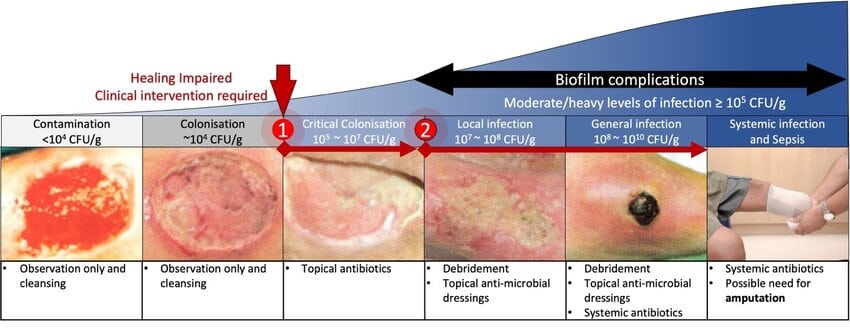
Source: Ozone as a Topical Treatment for Infected Dermal Wounds
Clinical assessment drives diagnosis. Documentation translates it into reimbursement defense.
Not every infected wound needs systemic antibiotics. Antimicrobial stewardship means using them only when necessary and documenting why.
Topicals are typically sufficient when:
Escalate to oral/IV when:
Documentation example:
"Localized wound infection identified. Initiated sharp debridement and cadexomer iodine. Topical approach chosen given the lack of systemic signs and stable medical status. If no improvement in 72 hours, will escalate to oral antibiotics. Patient counseled on monitoring and instructed to return if fever or red streaking develops."
Documenting clinical reasoning is what auditors look for.
You've treated the infection. So, when can you proceed with the graft?
Step 1: Clinical signs of active infection? If yes → WAIT. Document: "Infection treatment is ongoing. Graft deferred pending clearance."
Step 2: Lab values indicate infection? If WBC is elevated or cultures are positive → WAIT. Document: "Awaiting normalization of [labs] before therapy."
Step 3: Failed response to conservative control? If no response after 5 to 7 days → Consider systemic antibiotics first. Document: "Escalating to oral [antibiotic]. Will reassess after clearance."
Step 4: Can you document resolution? "Wound infection has resolved. Wound bed shows healthy granulation with no purulent drainage, no erythema, stable dimensions. Patient afebrile with normal WBC. Infection clearance documented. Patient meets criteria for advanced therapy."
If yes → Proceed with graft.
This framework is a documentation map showing payers you used sound judgment.
Some bioengineered skin substitutes have antimicrobial peptides, silver, or chitosan.
Does this change clearance requirements?
Clinical reality: In some cases, yes. Certain products manage bacterial load while supporting regeneration. With strong justification, you may apply the product in cases of controlled local infection.
Documentation reality: Justify clearly.
Example: "Wound exhibits controlled local infection (mild erythema, serosanguinous drainage, no purulence). Selected [product] for antimicrobial properties and healing support in bacterially colonized wounds. Clinical judgment: benefits outweigh risk given the antimicrobial profile and wound trajectory. Close monitoring planned."
This documents reasoning for deviating from typical clearance, which is defensible if audited.
Chronic wound infection management is complex. Colonization vs. infection. Topical vs. systemic. Wait vs. proceed.
These are judgment calls, and detailed documentation supports those calls when audited.
Let’s Talk About Our White Glove Service and Your Practice
Typically, no. Prescribing oral antibiotics is included in the E/M service. However, if an infection requires a separate, significant E/M on the same day as a procedure, you may use Modifier 25.
However, only do so if your documentation supports a separately identifiable assessment. IV administration may be separately billable.
There's no universal waiting period. The key is documented clearance, not time. Most clinicians reassess 3 to 7 days after initiating treatment.
If signs resolved (no purulent drainage, erythema improving, pain decreasing, healthy granulation), you can typically proceed at that visit. But only if you document clearance criteria.
Document immediately and adjust your plan. Notes should show:
This protects you from claims that you applied the amniotic membrane skin graft to an infected wound. Your documentation shows recurrence, not failure to clear original infection.
RenewMed's White Glove Service takes the complexity off your plate. We support your wound care program with:
Focus on healing patients, not claim denials.
Disclaimer: This content is created for licensed healthcare professionals, offering educational insights into wound care. It is not intended as medical advice or to replace your own clinical judgment when treating patients. We're here to support you, but the final treatment decisions should always be based on your professional evaluation of each unique patient's needs.
